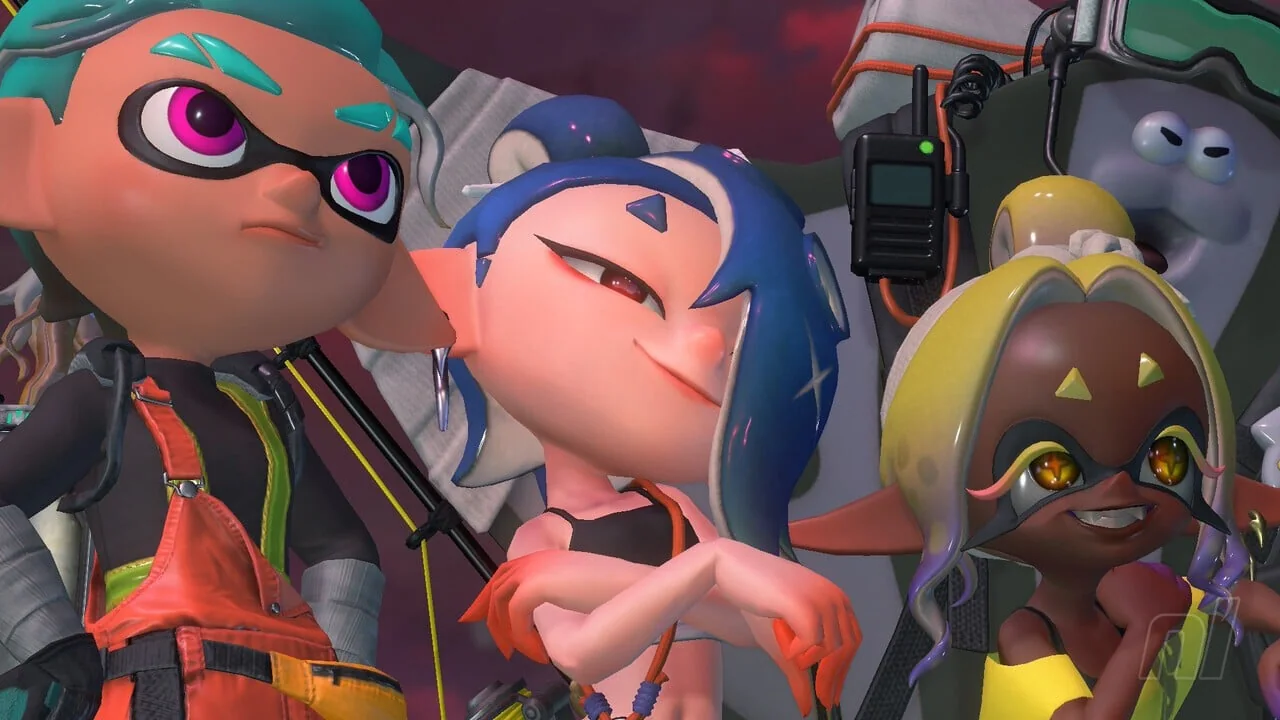
Splatoon Raiders has two meaningful ending milestones: the main-story ending that rolls the first credits and a post-game true ending reached at Bottomless Buffet floor 100. The first ending resolves the immediate campaign threat. The second completes the island expedition and the group's original goal of getting home. You do not select between them, and the true ending does not replace your first result; it continues the same cleared save.
This article is story analysis, not a floor-by-floor walkthrough. If you only need the unlock order, use the Splatoon Raiders post-game guide. It explains the Hidden Ruins and Bottomless Buffet while keeping the final story details behind a warning.
Spoiler-free answer: how many meaningful endings are there?
The most useful answer is two completion points. Defeating the campaign boss leads to the standard ending and credits. Loading the save afterward opens an epilogue route whose story culminates at floor 100. Players and guides commonly call that second sequence the secret or true ending.
You may see pages claiming four endings, including a “bad ending” caused by failing selected missions. That taxonomy is not corroborated by Nintendo Life's finished-game route, the documented boss progression, or Nintendo's own description of the campaign. A failed mission lets you try again; it should not be presented as a separate canonical ending without reliable in-game evidence. This explanation therefore focuses on the two sequences players can deliberately complete.
Full story spoiler warning: everything below names the campaign and post-game bosses, explains the post-credits clue, and describes what the true ending resolves.
What the story is really about
At the plot level, Splatoon Raiders is a stranded-island treasure hunt. Deep Cut and the Mechanic crash on the Spirhalite Islands, build the Hideout Ship, raid Salmonid territory for useful material and treasure, and search for a way back to the Splatlands. That setup gives every upgrade an immediate purpose: the ship is both the menu hub and the group's visible route home.
At the character level, the story is about people with very different talents becoming dependent on one another. This interpretation is grounded in Nintendo's own development explanation. Producer Seita Inoue said Deep Cut were placed at the center because their treasure-seeking, battle-ready personalities suit the premise. The Mechanic was created because the trio needed someone who could build Gadgets, work with their hands, and survive in an unforgiving environment.
Deep Cut's treasure-hunt premise
Shiver, Frye, and Big Man do not arrive as conventional rescuers. They are opportunistic adventurers, performers, and treasure hunters whose confidence keeps pulling the group deeper into danger. That makes the escalating raids believable within Splatoon's playful tone: of course Deep Cut respond to a mysterious island by wondering what they can recover from it.
But the ending is not simply a punishment for greed. Across the campaign, each member fights beside the Mechanic through an Exploration Bot and supplies a distinct Showstopper. Their appetite for treasure starts the motion; their willingness to stay in the fight makes the expedition a team story. The Briny Scrolls and Hideout conversations add background, but the clearest arc is visible in action: the trio increasingly entrust the Mechanic with the tools and decisions that keep everyone moving.
Why the Mechanic matters
The Mechanic is quiet and customizable, yet not narratively empty. Nintendo describes the character as a reserved craftsperson who is deceptively strong and unusually versatile. That design links story progress to player progress. Every repaired facility, crafted Gadget, improved Tank, and leveled weapon says something the dialogue does not need to repeat: this expedition survives because the Mechanic can turn salvage into a solution.
That is why the Hideout Ship matters at the climax. It is not scenery waiting for a cutscene. It is the material record of the player's work, built from the same raid-and-upgrade loop that powered the campaign. When the finale returns attention to the ship, the story and the progression system finally point at the same achievement.
What happens in the main ending
The campaign climax takes the Mechanic into the Throne Room against Salmonarch. The encounter begins as a surfboard ascent through hazards before shifting to floating platforms around the boss. The Mechanic uses Bot Hop to move between positions, defeats Salmonids and Power Egg targets to build attack opportunities, and launches Drill Attacks against Salmonarch's three heads.
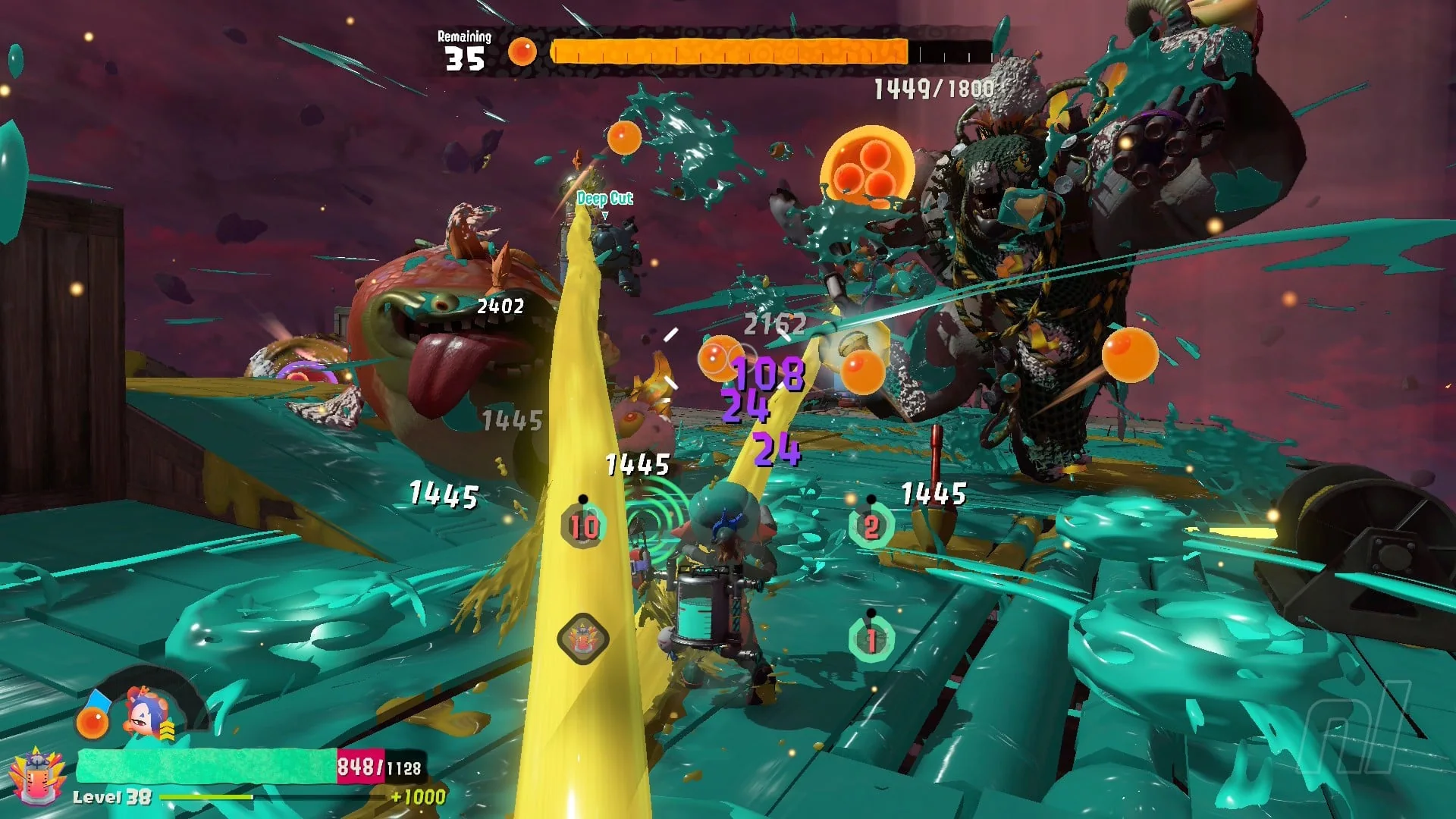
After the three heads fall, the action turns back toward the Hideout Ship and its crane for the finishing sequence. That return is the mechanical payoff described above: the improvised home the group built together becomes part of their answer to the largest threat they have faced. The boss falls, the immediate crisis ends, and the first credits roll.
Salmonarch and the Throne Room climax
Salmonarch is the main-story final boss, not a lesser version of the floor-100 opponent. The distinction matters because the two fights serve different narrative functions. Salmonarch is the climax of the campaign's outward journey through the Spirhalite Islands. It tests the movement, Bot Buddy coordination, crowd control, and upgrading habits the story has taught.
The spectacle also enlarges the scale of the conflict without abandoning the game's central partnership. The Mechanic cannot treat the Exploration Bot as optional movement tech, and Deep Cut's presence is built into the route. In a story explicitly designed to give the trio a central role, the final campaign encounter makes cooperation a physical requirement rather than a sentimental speech.
Why the first credits are intentionally incomplete
The first ending is a valid campaign ending: it resolves Salmonarch and rewards the player with credits. It is incomplete only in the deliberate sense that the credits themselves show a new question. Players who watch to the end see a circular mark with three golden beams, a visual that does not belong to the route they just completed.
Loading the clear save turns that image into navigation. Deep Cut draw attention to the new development, and three Hidden Ruins appear around the islands. The credit sequence therefore works as more than a teaser for optional combat. It tells the player that the mysteries and treasure of the Spirhalite Islands have not been fully accounted for.
What the post-credits clues mean
The three beams correspond to Fischflak, Smoksam, and Myunyere Hidden Ruins. Each contains separate challenges for the Power, Speed, and Tactical Tanks. Finishing the required routes produces different Relic parts; assembled together, those parts open the way to the Bottomless Buffet beneath the Throne Room.
Functionally, the clue is a progression map. Thematically, it changes the meaning of the credits. The group could treat survival and the defeat of Salmonarch as enough, but the unexplained structure calls them back. Deep Cut's defining curiosity will not let the expedition end with an unopened door, while the Mechanic's growing mastery makes opening it possible.
That second point is interpretation rather than a line spoken by the game. The confirmed facts are the image, the three Ruins, the Relic parts, and the gate. The idea that the sequence represents curiosity overcoming caution is a reading of how those facts fit the characters Nintendo says it wanted to spotlight.
What happens in the true ending
The Bottomless Buffet is a long post-game climb that begins at Salmonid Level 50, locks the action to Survivalist difficulty, and raises the enemy level as the floors advance. Its randomized challenges can continue indefinitely, but floor 100 is the end of the story route. Reaching that point reveals Lord Saltimatum, the post-game secret boss.
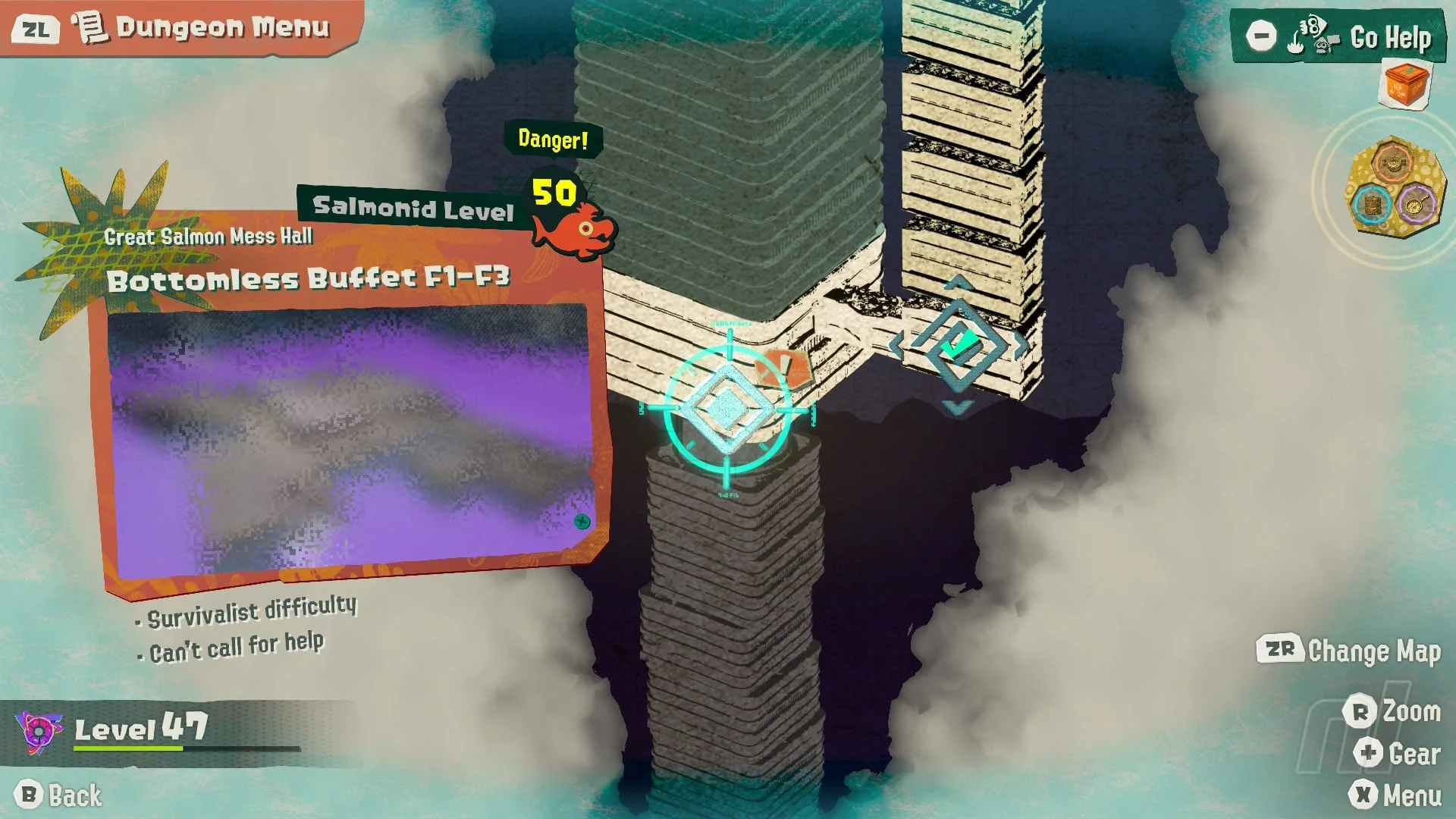
Defeating Lord Saltimatum triggers the true-ending sequence. The expedition's Relics are totalled, and Deep Cut and the Mechanic set sail back toward the Splatlands. The game does not need to erase the first ending to make this one feel final. The first credits say the party survived the island's central campaign threat; the true ending says their expedition is complete and the return journey can finally begin.
Lord Saltimatum on floor 100
Lord Saltimatum is best understood as the final challenge of the epilogue, not as evidence that Salmonarch was a false boss. The campaign and post-game have separate climaxes because they answer separate questions. Salmonarch asks whether the improvised team can survive the threat at the center of the islands. Lord Saltimatum asks whether a fully developed raider can finish the mystery left behind by the credits.
The reward reinforces that post-game role. Defeating Lord Saltimatum grants the Endless Search Relic Power, which helps locate undiscovered Gadget parts and can be equipped separately from other Relic Powers. It is a completion reward that points outward: the story has concluded, but players who enjoy collecting and buildcraft can keep searching.
Returning to the Splatlands
Returning home was part of the official premise from the beginning. The group crash-lands, creates a Hideout Ship, and raids for the means to leave. The true ending pays off that simple objective only after the optional-looking Relic mystery has been resolved. The ship is now capable of departure, the expedition's finds are counted, and the group sails toward the world from which the story removed them.
That is a quieter conclusion than introducing another city-threatening twist, and it suits the game. Raiders is a spin-off focused on Deep Cut living and working together away from their familiar stage. Its final image does not have to answer every question in Splatoon lore. It needs to show that this particular adventure changed a group of stranded treasure hunters into a functioning crew—and that crew can go home.
What the ending says about Deep Cut and the Mechanic
Nintendo's stated goal was to explore Deep Cut more fully than Splatoon 3's campaign allowed. Raiders accomplishes that by giving their personalities practical consequences. Their taste for risk initiates missions; their Bot Buddy roles shape combat; their needs make the Mechanic's inventions necessary. The story lets players spend time with them as companions rather than briefly meeting them as colorful rivals.
The Mechanic, meanwhile, is defined through competence. They do not compete with Deep Cut for the loudest personality. They create the conditions in which the trio can succeed. By the true ending, “Mechanic” no longer feels like a generic job label. It names the contribution that repaired the ship, adapted the loot, crossed the islands, and carried the team through two separate finales.
My reading is that the final departure makes the relationship reciprocal. Deep Cut supply daring, direction, and companionship; the Mechanic supplies endurance and solutions. Neither side simply rescues the other. The treasure hunt succeeds because those strengths become a shared routine, which is why the repeated cycle of raiding and returning to the Hideout supports the character story instead of interrupting it.
Salmonid lore: what is confirmed and what is still theory
The game confirms that Salmonarch and Lord Saltimatum are distinct encounters with distinct positions in progression. Salmonarch rules the campaign climax in the Throne Room; Lord Saltimatum waits at the end of the floor-100 route. The sequence also gives players more evidence about Salmonid culture through areas, Relics, enemies, and boss presentation.
Community discussions go further, suggesting that Lord Saltimatum may represent an earlier ruler or that “Salmonarch” is a recurring title. Those ideas can fit visual clues, including the bosses' scale and mineral-like imagery, but they remain interpretations unless an in-game record or Nintendo statement confirms the relationship. Treat a clever Reddit theory as a lens, not as a missing line of canon.
That uncertainty is not a flaw in the ending. Splatoon regularly leaves environmental details open for players to connect. The true ending closes the Mechanic and Deep Cut's travel objective while leaving enough Salmonid history unexplained to reward reading the site wiki and revisiting the islands.
Splatoon Raiders ending FAQ
Is there a bad ending?
No reliable finished-game source used for this analysis documents a separate canonical bad ending triggered by mission failure. Some competing pages claim one, but the claim is not corroborated. The supported structure is the main-story credits followed by the post-game true ending.
Do you need every Relic?
You need the Relic parts awarded by completing the required Tank-specific Hidden Ruins challenges to open the Bottomless Buffet. Do not confuse that gate with collecting every optional Relic entry across the entire game.
Is Lord Saltimatum the real final boss?
Lord Saltimatum is the post-game secret final boss and the last boss on the true-ending route. Salmonarch remains the main campaign's final boss. Calling either one “fake” obscures their different roles.
Can you continue after the true ending?
Yes. Bottomless Buffet continues with randomized challenges beyond floor 100, and the Endless Search reward supports unfinished Gadget-part collection. You can also return to island missions, Super Spicy variants, multiplayer, and other completion goals.
Loading comments...